Tips
How to Choose the Right Demolition Company in Montreal
RBQ licence, $40,000 bond, CNESST certificate, written quote, a 10 to 15% holdback: how to check a demolition company in Quebec before you sign.
RBQ License
5797-3208-01
CNESST Certified
Job Site Safety
APCHQ Member
Provincial Association
Liability Insurance
$5,000,000
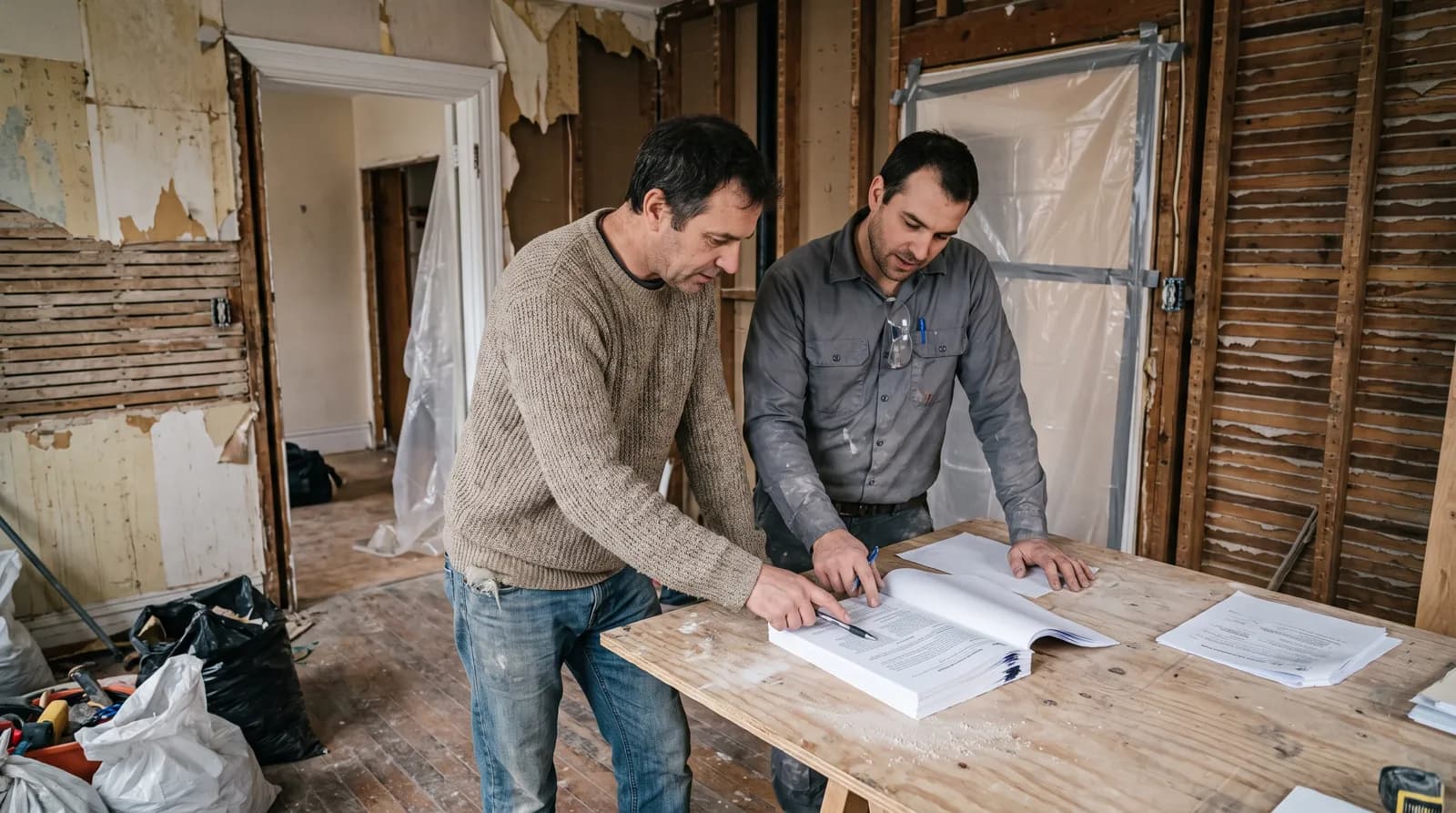
When you hire a demolition company, you're choosing who gets to open up your walls. Get it wrong and you can lose a deposit, end up with an abandoned job site, spread asbestos through the house or collect a fine from the city.
The good news: almost everything can be checked. Quebec's building authority, its workplace safety board and its consumer protection office all offer free public tools. Here's how to use them, and what to ask before you sign.
What licence does a demolition contractor need in Quebec?
In Quebec, anyone who carries out construction work must hold a licence from the Régie du bâtiment du Québec (RBQ), and demolition counts as construction work. The subclass designed for demolition is 2.7, site work contractor.
One nuance matters. According to the RBQ, a licensed contractor may also demolish within its own subclass. So the general contractor redoing your kitchen can tear it out. What nobody can do is work with no licence at all.
To check, type the company name or licence number into the RBQ licence holder register. You'll see the subclasses held, any restrictions, and the claims made against the company's bond over the past five years.
Good to know
Working without a licence is expensive for the contractor. Under the RBQ's 2026 schedule, the fine runs from $14,098 to $105,734 for an individual, and from $42,292 to $211,465 for a company. A contractor who hesitates to give you a licence number is already telling you something.
What does the RBQ licence bond cover?
Every licensed contractor posts a bond: $40,000 for a general contractor and $20,000 for a specialty contractor, according to the RBQ. That money is set aside to compensate clients who've been wronged. It only applies if the licence was valid when the contract was signed.
You have three years from the day you discover the problem to file a claim. If several clients claim at once and the total exceeds the bond, the money is split between them pro rata.
A draft regulation published by the RBQ in February 2026 would raise these amounts to $60,000 and $30,000. As of September 2026, it was still under review, so the amounts in force remain $40,000 and $20,000.
Why ask for a CNESST compliance certificate?
The CNESST, Quebec's workplace health and safety board, can hold an employer liable for the unpaid premiums of a contractor it hires. The amount is based on the labour cost of the contract. A compliance certificate (attestation de conformité), requested for each contract, releases you from that liability.
This mainly concerns general contractors and property managers who subcontract demolition. The request goes through Mon Espace CNESST. The subcontractor has 14 days to object, and silence counts as consent.
Are you a homeowner? Ask anyway. A company that declares its workers to the CNESST will confirm it without hesitation. One that changes the subject has given you its answer.
What should a serious demolition quote include?
Quebec's Office de la protection du consommateur (OPC) recommends a detailed written contract before any renovation work. For demolition, the quote is where surprises show up in advance. Here's what it should spell out.

- 1The exact scope of work
Which rooms, which surfaces, and what stays. "Demolish the kitchen" isn't enough: are the cabinets, flooring, ceiling and partitions included?
- 2Protection of lived-in rooms
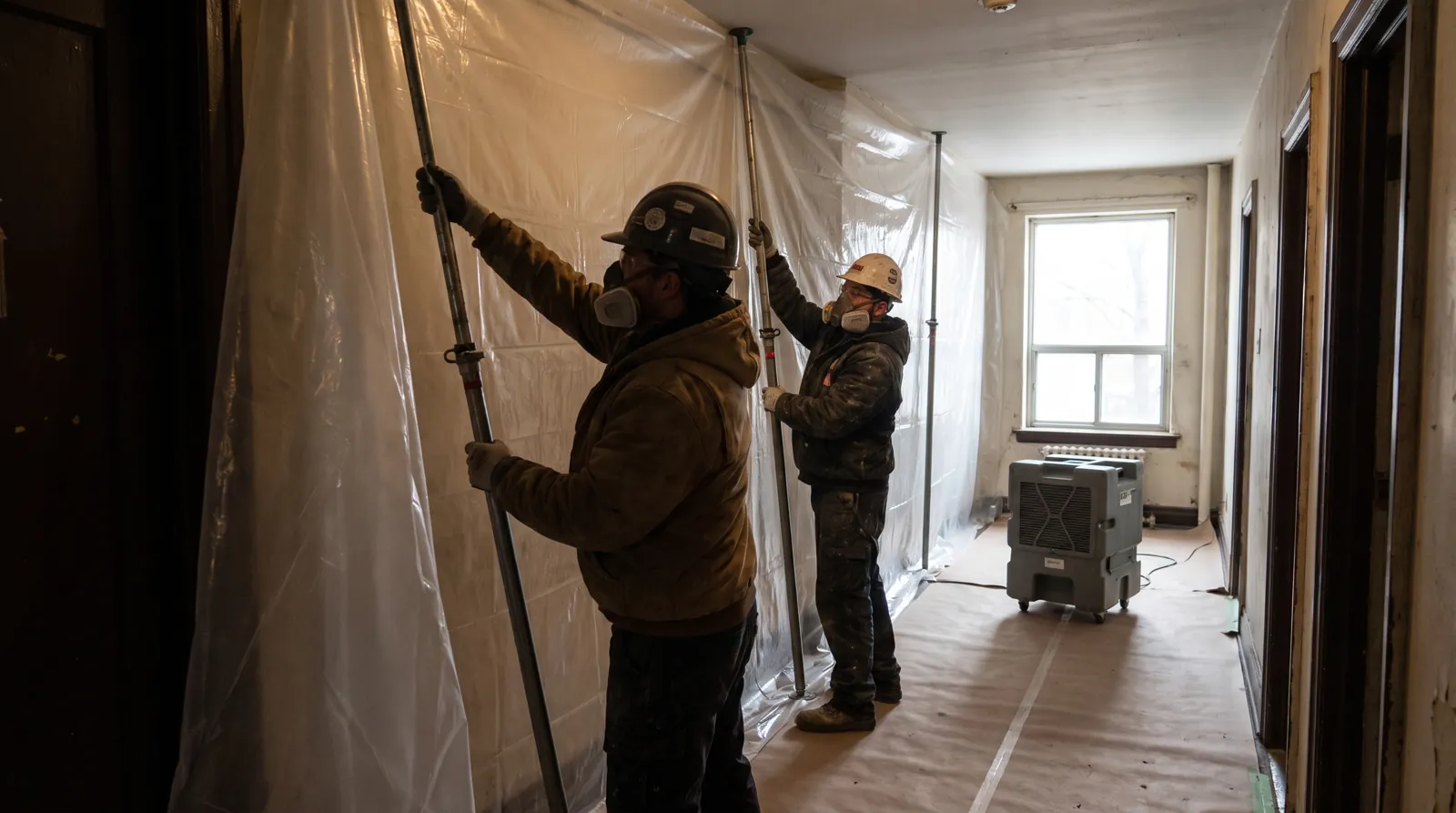
Dust barriers, floor protection, air filtration. If you're living at home during the work, this is the line that matters most.
- 3Debris and the dumpster
Sorting, hauling and disposal. In Montreal, a dumpster on public property needs a temporary occupancy permit from the borough, and it goes in the street or lane, never on the sidewalk.
- 4Permits
Who applies and what it costs. City fees should appear as they are.
- 5Asbestos
In an older building, the quote should plan for an asbestos survey before the work, not after.
- 6Schedule, payments and warranty
Start date, expected duration, payment schedule and the warranty on labour.
A complete quote also lets you compare. Two prices only mean something if they cover the same work. For a sense of the amounts involved, read our article on interior demolition costs in Montreal.
Who applies for the permit?
In Montreal, a permit is required for work that affects the walls or foundations of a dwelling, or that changes the layout of the rooms. The owner can apply, or a contractor acting on the owner's behalf. Each of the 19 boroughs has its own permit counter, so timelines vary. Our demolition permit guide walks through the process.
How do you pay a demolition company without taking a risk?
The OPC advises avoiding a deposit or keeping it very small, paying as the work progresses, and holding back a final payment of 10 to 15% of the total until the job is finished. That holdback keeps the crew motivated right up to the last load of debris.
A contractor who wants full payment before starting, or cash with no invoice, leaves you with no leverage. If the company closes or walks off the job, the RBQ bond becomes your only recourse, and it's capped.
Asbestos: the question that separates serious companies
The CNESST requires checking for asbestos before work that could release its dust. Buildings constructed before February 15, 1990 must be inspected for sprayed-on insulation (flocage), and those built before May 20, 1999 for pipe and boiler insulation (calorifuge).
The rule goes further: any material likely to contain asbestos is presumed to contain it until an analysis proves otherwise. A serious demolition company will ask when your home was built before giving you a price. One that doesn't ask probably hasn't planned for it in the quote.
Asbestos removal is handled by specialized firms. At Kasa Demolition, we coordinate asbestos and mould removal with those certified firms before any demolition. To recognize suspect materials, read how to know if your house has asbestos.
Red flags to watch for
Most bad experiences announce themselves on the first call. Be wary of a company that:
- gives you a firm price without seeing the site;
- says no permit is needed, without checking with the borough;
- won't give you its RBQ licence number or put it on the quote;
- asks for a large deposit or full payment up front;
- never mentions debris, dust or asbestos;
- pushes you to sign the same day.
Did someone knock on your door? Contracts signed at home with a door-to-door merchant are regulated, with a 10-day cancellation period. Check with the OPC whether your situation is covered. The OPC's Get information about a merchant tool also shows whether the Office has already taken action against a business.
What should you ask before signing?
These questions take ten minutes on the phone. A demolition company that answers them clearly, and in writing, has done its homework.
Then check it yourself in the register.
Ask for the coverage amount and written proof.
The answer should be specific, not "we'll see".
Barriers, floor protection, air filtration.
Work stops, a sample is analysed, a certified firm steps in. No improvising.
Sorting and disposal are part of the job.
Staged payments, a final holdback, a written warranty on labour.
Check us out before you call
Kasa Demolition holds RBQ licence 5797-3208-01, which you can look up in the register. We're registered with the CNESST, members of the APCHQ and covered by $5,000,000 in civil liability insurance. Permit management is included in the quote, and our labour is guaranteed for one year.
Get a quoteIn short
A good demolition company is one that lets you check: its licence in the RBQ register, its CNESST registration, a detailed written quote, and its plan for asbestos and debris.
Pay in stages, keep a holdback until the end, and be wary of any price given without a site visit. Planning a renovation? See how an interior demolition unfolds.
Sources accessed September 25, 2026
- Régie du bâtiment du Québec, Check a contractor's licence
- Régie du bâtiment du Québec, Effectuer une réclamation au cautionnement
- Régie du bâtiment du Québec, Amendes
- CNESST, Services de vérification de conformité
- CNESST, Amiante
- Office de la protection du consommateur, Before hiring a renovation contractor
- Ville de Montréal, Rénover l'intérieur d'un bâtiment
- Ville de Montréal, Obtenir un permis pour conteneur à débris de construction
Samuel Perez
Co-Founder, Kasa Demolition
Samuel Perez is co-founder of Kasa Demolition and oversees business development. Bilingual in French and English, he makes sure every client understands their project and receives transparent service from the first call through to final delivery.
Frequently asked questions
The most common questions before hiring a demolition company.
Enter the company name or licence number in the RBQ licence holder register, which is free and online. It shows the subclasses held, any restrictions, and claims made against the company's bond over the past five years.
RBQ subclass 2.7, site work contractor, is the one designed for demolition. According to the RBQ, a licensed contractor may also demolish within its own subclass. What matters is a valid licence that covers the planned work.
Quebec's Office de la protection du consommateur advises avoiding a deposit or keeping it very small, paying as work progresses, and holding back 10 to 15% of the total until the job is done. A contractor asking for full payment up front is a red flag.
The owner, or a contractor acting on the owner's behalf, applies to the borough. A permit is required for work that affects the walls or foundations of a dwelling. At Kasa Demolition, permit management is included in the quote.
If the RBQ licence was valid when you signed, you can claim against the bond: $40,000 for a general contractor, $20,000 for a specialty contractor. It covers deposits for work never done and unfinished work. You have three years from discovering the problem.
Ready to start your demolition project?
On-site assessment included. Available 7 days a week, 8 AM to 10 PM.